
Currently Empty: ₨ 0

Quick answer: A pink salt block is a thick slab of natural Himalayan rock salt used to cook, sear and serve food. You heat it slowly in three stages (low, medium, high, about 15 minutes each) until it reaches roughly 200 to 260°C, then cook thin foods such as prawns, steak, eggs and vegetables directly on it. It adds a light, natural saltiness. Thinner pink salt tiles and salt bricks are used for serving platters and glowing salt walls. Clean a salt block with a damp cloth only, never soap or soaking.
A Himalayan pink salt block turns an ordinary meal into a show at the table. The same pink rock salt that fills your salt shaker can be cut into thick slabs for grilling, thin plates for serving, and bricks and tiles for building glowing walls. This guide explains the different types of pink salt blocks and tiles, how to cook on a salt block step by step, what to cook, how to clean and store it, and what they cost in Pakistan.
Key takeaways
- Pink salt blocks and tiles are cut from rock salt mined in the Salt Range of Punjab, Pakistan.
- Cooking blocks must be thick and completely dry, and heated slowly to avoid cracks.
- Food cooked on a salt block picks up a gentle salty flavour, so you need little or no extra salt.
- Chilled salt plates make striking serving boards for fruit, cheese, sushi and desserts.
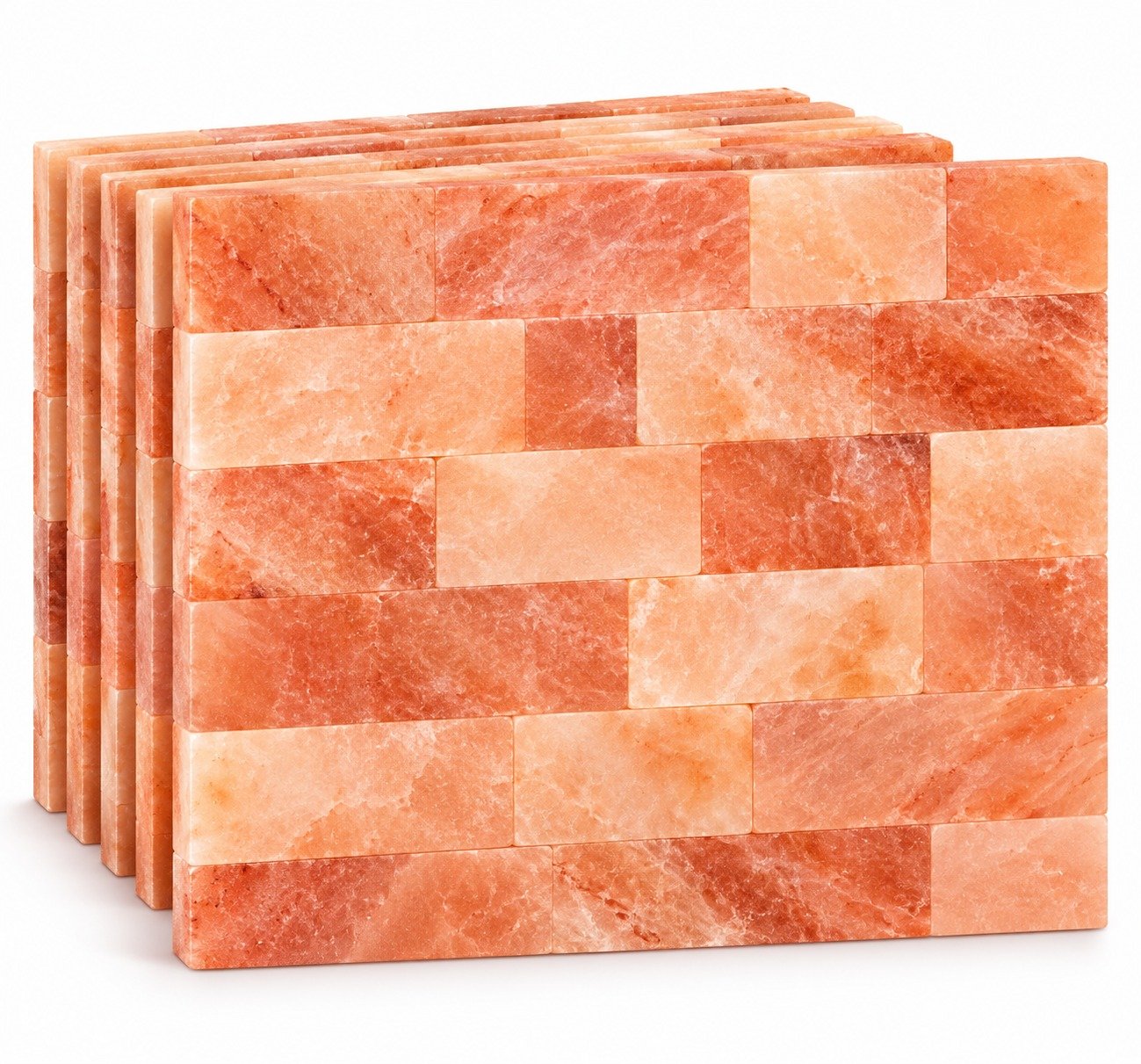
- Thin tiles and bricks are used for backlit salt walls in homes, spas and restaurants, not for cooking.
In this guide
- What is a pink salt block?
- Salt blocks vs salt plates vs salt tiles vs salt bricks
- How to cook on a Himalayan salt block
- What to cook on a salt block
- Using a salt block cold for serving
- How to clean and store a salt block
- Pink salt tiles and bricks for walls
- Pink salt block price in Pakistan
- How to choose a good salt block
- Frequently asked questions
What is a pink salt block?
A pink salt block, also called a Himalayan salt slab, salt cooking plate or salt stone, is a solid piece of natural pink rock salt cut into a flat rectangle or square. It is used as a cooking surface, a serving platter, or a building material.
The salt is not mined in the high Himalaya but in the Salt Range of Punjab, Pakistan, home of the famous Khewra Salt Mine. Large salt boulders are cut with saws, then shaped and smoothed by hand. The pink, orange and white colours come from natural traces of minerals, so every block has its own pattern.
Rock salt is dense and holds heat for a long time once it is hot. That is why a thick salt block can sear food like a cast-iron pan, while also adding its own mild seasoning.
Salt blocks vs salt plates vs salt tiles vs salt bricks
These names are often mixed up. The main difference is thickness and purpose:
| Type | What it is | Best for |
|---|---|---|
| Salt cooking block / slab | Thick, heavy slab built to be heated | Searing, grilling and BBQ |
| Salt plate | Thinner, often polished plate or platter | Serving chilled food, gentle warming |
| Salt wall tile | Thin panel for cladding walls | Backlit feature walls and spas |
| Salt brick / building block | Rectangular brick for stacking | Salt walls, salt rooms, saunas, counters |
Important: only thick, food-grade blocks should be heated for cooking. Thin plates and decorative tiles can crack under strong heat.
An Organocity Himalayan pink salt cooking tile, made for grilling and searing.
How to cook on a Himalayan salt block: step by step
The secret to a long-lasting salt block is slow heating. Salt expands as it warms, and sudden heat or trapped moisture can crack it.
- Make sure the block is completely dry. If it has been washed, let it air-dry for at least 24 hours. Moisture inside the salt is the main cause of cracks.
- Place it on a cold heat source. Put the block on a gas stove, a BBQ grill or a charcoal grill before you switch on the heat. On an electric or glass-top stove, rest it on a metal ring (such as a wok ring) so it does not sit directly on the element.
- Heat in three stages. Use low heat for about 15 minutes, then medium for 15 minutes, then high for 15 minutes. Larger blocks may need a little longer.
- Check the temperature. The block is ready at roughly 200 to 260°C (400 to 500°F). Without a thermometer, sprinkle a few drops of water on it: they should sizzle and disappear almost instantly.
- Cook quickly. Lightly oil the food, not the block, and place it on the hot salt. Thin pieces sear in a minute or two per side.
- Let it cool slowly. Turn off the heat and leave the block where it is. It can stay hot for hours, so do not move it, put it in water or place it on a cold surface.
Tip: always cook on the same side of the block. Over time it will develop small cracks and turn whiter. This is normal and does not affect cooking.
Oven use: it is safer to heat the block on the stove or grill first, then move it into a hot oven on a metal tray, rather than heating it from cold inside the oven.
What to cook on a salt block
Salt blocks work best with foods that cook quickly, because the longer food sits on the salt, the saltier it becomes. Moist foods also absorb more salt than dry ones.
- Seafood: prawns, scallops and thin fish fillets.
- Thin cuts of meat: beef or mutton steak strips, chicken tikka pieces, seekh-style kebabs and thinly sliced liver.
- Eggs: fried eggs cook beautifully and need no added salt.
- Vegetables: mushrooms, capsicum, courgette, asparagus, onion rings and sliced paneer.
- Fruit: pineapple, peaches and watermelon slices caramelise and take on a sweet-salty taste.
Avoid: very wet foods, heavily marinated meat dripping with liquid, and thick cuts that need a long cooking time. These dissolve more salt and can taste too salty.
Using a salt block cold for serving
A salt block does not have to be heated. Chilled in the fridge for an hour or two, it becomes a cold serving platter that keeps food cool and adds a hint of salt.
- Fruit platters, such as melon, mango and strawberries
- Cheese, cured meats and crackers
- Sushi, sashimi and ceviche
- Butter, chocolate and ice-cream desserts
A polished Himalayan salt plate is ideal for this and makes an unusual gift for food lovers.
How to clean and store a salt block
- Let it cool completely. This can take several hours after cooking.
- Scrape off food. Use a spatula or a soft brush for stuck-on bits.
- Wipe with a damp cloth or sponge. Use as little water as possible. The salt itself is naturally antimicrobial.
- Never use soap, never soak it, and never put it in a dishwasher. Water dissolves the salt.
- Dry it well. Pat it with a towel, then leave it to air-dry for 24 hours.
- Store it somewhere dry. In humid areas, or during the monsoon, wrap it in a cloth or keep it in a sealed container.
With good care, a salt block can be used many times. It gets thinner and lighter with use. When it becomes too thin or cracked to cook on, use it as a serving plate, or grate it as cooking salt.
Pink salt tiles and bricks for walls
Himalayan salt tiles and pink salt bricks are cut from the same rock salt but are made for building, not cooking. When lit from behind with warm LED lights, a wall of salt tiles glows soft pink and orange, like a giant salt lamp.
Popular uses
- Feature walls in lounges, bedrooms and offices
- Reception counters, partitions and bar fronts in restaurants and cafés
- Spas, saunas and salt rooms
- Shop displays and hotel lobbies
Installation tips
- Fix tiles or bricks to a rigid backing with a suitable adhesive or salt-based mortar. For large walls, use an experienced installer.
- Use warm white LED strips (around 2,700 to 3,000 K) behind the salt, with space for heat to escape.
- Keep salt walls away from damp areas such as bathrooms and outside walls, and make sure the room is well ventilated.
Read more about salt walls and the glow of salt in our guide to salt lamp benefits and salt bricks.
Himalayan salt wall tiles glow warmly when backlit.
Pink salt block price in Pakistan
The price of a pink salt block depends on its size, thickness, finish (raw or polished) and purpose. Thick cooking slabs cost more than thin tiles, and bricks are usually priced per piece. Current Organocity prices:
| Product | Use | Price |
|---|---|---|
| Himalayan Pink Salt Cooking Tiles | Grilling, searing, serving | Rs 1,600 Rs 2,000 |
| Himalayan Salt Plate | Serving chilled food, light warming | Rs 650 Rs 1,000 |
| Himalayan Salt Wall Tiles | Backlit feature walls | Rs 300 Rs 400 |
| Natural Himalayan Pink Salt Building Blocks | Salt walls, salt rooms, saunas | Rs 200 Rs 300 |
Prices were checked in November 2026 and may change, so please see each product page for the latest price. Restaurants, spas, builders and exporters can request a wholesale quote for bulk salt blocks, bricks and tiles. Every order ships with cash on delivery across Pakistan.
How to choose a good pink salt block
- Thickness for cooking: choose a thick, heavy block for heating. Thin plates are better for cold serving.
- Food grade: make sure a cooking block is sold as food grade and comes from a clear source such as the Salt Range of Pakistan.
- Few cracks and clean surface: small natural veins are fine, but avoid blocks with deep cracks running right through.
- Natural colour: real pink salt has mixed pink, orange and white tones, not a single bright, even colour.
- Size for your stove or grill: the block should sit flat and stable on your burner or grill grate.
Frequently asked questions
What is a pink salt block used for?
A pink salt block is used to cook and sear food such as prawns, steak, eggs and vegetables, to serve chilled food like fruit, cheese and sushi, and, in the form of tiles and bricks, to build glowing salt walls.
How do you heat a Himalayan salt block?
Put the dry block on a cold stove or grill, then heat it slowly: about 15 minutes on low, 15 minutes on medium and 15 minutes on high, until it reaches roughly 200 to 260°C. Heating too fast can crack it.
Does food cooked on a salt block taste salty?
It takes on a light, natural saltiness. Thin, quick-cooking foods pick up just a little salt, while wet foods or food left on the block for a long time become saltier. You usually do not need to add extra salt.
How do you clean a salt block?
Let it cool completely, scrape off food, then wipe it with a damp cloth or sponge. Do not use soap, do not soak it, and do not put it in a dishwasher. Dry it with a towel and let it air-dry for 24 hours.
Why did my salt block crack?
Cracks are usually caused by moisture inside the salt or by heating and cooling too fast. Make sure the block is fully dry and always heat it slowly. Small surface cracks and a whiter colour over time are normal.
Can I use a salt block on an electric or glass stove?
Yes, but do not place it directly on the element or glass. Rest it on a metal ring, such as a wok ring, and heat it slowly in the same way as on a gas stove.
How long does a salt block last?
With slow heating and gentle cleaning, a cooking block can be used many times. It slowly becomes thinner. Once it is too thin or cracked for cooking, you can still use it as a serving plate.
What is the price of a pink salt block in Pakistan?
At Organocity, Himalayan pink salt cooking tiles are Rs 1,600, salt serving plates are Rs 650, salt wall tiles are Rs 300 and salt building blocks are Rs 200 per piece, with cash on delivery across Pakistan.
Cook, serve and build with real Himalayan pink salt
Organocity salt cooking tiles, salt plates, wall tiles and building blocks are cut from natural pink salt from Pakistan’s Salt Range and delivered with cash on delivery all over Pakistan. Bulk and export orders welcome.
Related guides: Salt lamp benefits, price in Pakistan and salt bricks · Pink salt benefits, uses and side effects · Shop edible Himalayan pink salt
References
- The Manual. How to cook on a Himalayan salt block. themanual.com
- Gewürzhaus. How to cook on a salt slab. gewurzhaus.com.au


[…] and Himalayan salt wall tiles from Rs 300. For cooking blocks, salt plates and wall tiles, see our pink salt block and tiles guide. Projects needing hundreds of bricks can ask for a wholesale […]