Currently Empty: ₨ 0
Pink Salt Benefits, Uses and Side Effects: Himalayan Pink Salt vs Kala Namak
Himalayan pink salt has become a kitchen staple across Pakistan and around the world. But what are the real pink salt benefits, and how is it different from ordinary table salt and black salt (kala namak)? This guide gives you honest answers: what pink salt is, how to use it, its possible side effects, and how to choose real pink salt at a fair price in Pakistan.
Key takeaways
- Pink salt is rock salt mined from the Salt Range in Punjab, Pakistan. It is mostly sodium chloride with small amounts of natural minerals.
- Its main advantages are that it is unrefined, free from anti-caking additives, and has a pleasant taste and texture.
- It contains about as much sodium as table salt, so use it in moderation.
- Pink salt is not iodised. Make sure you get iodine from iodised salt or your diet.
- Kala namak (black salt) has a tangy, sulphurous flavour and is best for chaat, raita and drinks.
What is Himalayan pink salt?
Himalayan pink salt is a natural rock salt formed from ancient sea beds that dried up millions of years ago. Despite its name, most of it comes from the Salt Range in Punjab, Pakistan, home to the famous Khewra Salt Mine, one of the oldest and largest salt mines in the world. In Urdu it is often called gulabi namak or sendha namak.
The pink, orange and red shades come from tiny amounts of minerals such as iron. Pink salt is roughly 95 to 98 percent sodium chloride. The rest is made up of trace minerals including potassium, magnesium and calcium.
Pink salt benefits: what is true?
Pink salt is a good salt, but it is not a medicine. Here are the benefits that hold up:
- Unrefined and additive-free: Most pink salt is simply crushed and packed, without the anti-caking agents found in many refined table salts.
- Natural taste and texture: Many people prefer its clean, mild flavour, and coarse crystals add a pleasant crunch.
- Can help you use less salt: Coarse crystals are larger, so a teaspoon of coarse pink salt holds less salt than a teaspoon of fine table salt. This only helps if you measure by volume and do not add extra.
- Versatile: The same salt works for cooking, the dining table, grinders and pickling, and pink salt blocks can be used to cook and serve food.
What about the trace minerals? A 2020 Australian study that tested pink salt samples found that the minerals are present in such small amounts that you would need to eat an unsafe amount of salt to get any meaningful nutritional benefit. Enjoy pink salt for its taste and purity, not as a mineral supplement.
How to use pink salt
- Everyday cooking: Use fine grain pink salt in salan, daal, rice, roti dough and baking, exactly as you would use table salt.
- At the table: Fill a shaker or use an edible pink salt grinder jar for salads, eggs, fruit and BBQ.
- Grilling and serving: Heat a Himalayan salt cooking tile slowly to sear steak, chicken tikka, prawns and vegetables, or chill it to serve fruit and desserts.
- Pickles and preserving: Pink salt works well for achar and brines.
- Around the home: Pink salt is also used in bath soaks and, in larger pieces, as Himalayan salt lamps that give a warm, calming glow.
Pink salt side effects and precautions
- Too much sodium: Pink salt is still salt. Eating too much sodium raises blood pressure and the risk of heart disease and stroke. The World Health Organization recommends less than 5 g of salt a day for adults, about one level teaspoon, counting the salt already in food.
- No iodine: Unlike iodised table salt, pink salt has almost no iodine. Iodine is essential for the thyroid, and iodine deficiency is still a concern in parts of Pakistan. If you switch completely to pink salt, keep using some iodised salt or make sure your diet includes iodine sources such as dairy, eggs and fish.
- Medical advice: If you have high blood pressure, kidney disease or heart problems, follow your doctor’s advice on total salt intake, whatever type of salt you use.
Pink salt vs black salt (kala namak) vs table salt
Kala namak in English is simply “black salt”. It is traditionally made by heating rock salt with herbs and seeds such as harad (black myrobalan) at very high temperatures. This creates sulphur compounds that give kala namak its famous egg-like smell and tangy taste. Despite the name, ground kala namak usually looks pinkish-grey.
| Pink salt | Black salt (kala namak) | Table salt | |
|---|---|---|---|
| Source | Mined rock salt, Salt Range, Pakistan | Rock salt heated with herbs | Refined salt from mines or sea |
| Taste | Mild and clean | Tangy, savoury, sulphurous | Sharp and salty |
| Processing | Crushed, unrefined | Heated, then ground | Refined, often with anti-caking agents |
| Iodine | Very little | Very little | Added (if iodised) |
| Best for | Daily cooking, table, grilling | Chaat, raita, chutney, shikanjvi | Daily cooking and baking |
Most Pakistani kitchens benefit from keeping both: pink salt for everyday cooking and a small jar of kala namak for fruit chaat, dahi baray, raita and cool summer drinks.
How to identify real pink salt
- Natural colour variation: Real pink salt has a mix of light pink, deep pink and almost white crystals. Perfectly even, bright pink colour can be a sign of dye.
- Water test: Dissolve a spoonful in a glass of water. Real pink salt leaves the water almost clear, sometimes with a little natural sediment. Water that turns bright pink suggests added colour.
- Taste: It should taste clean and salty, with no bitter or chemical aftertaste.
- Packaging: Buy food grade salt in sealed, labelled packs from a brand with clear contact details.
Pink salt price in Pakistan
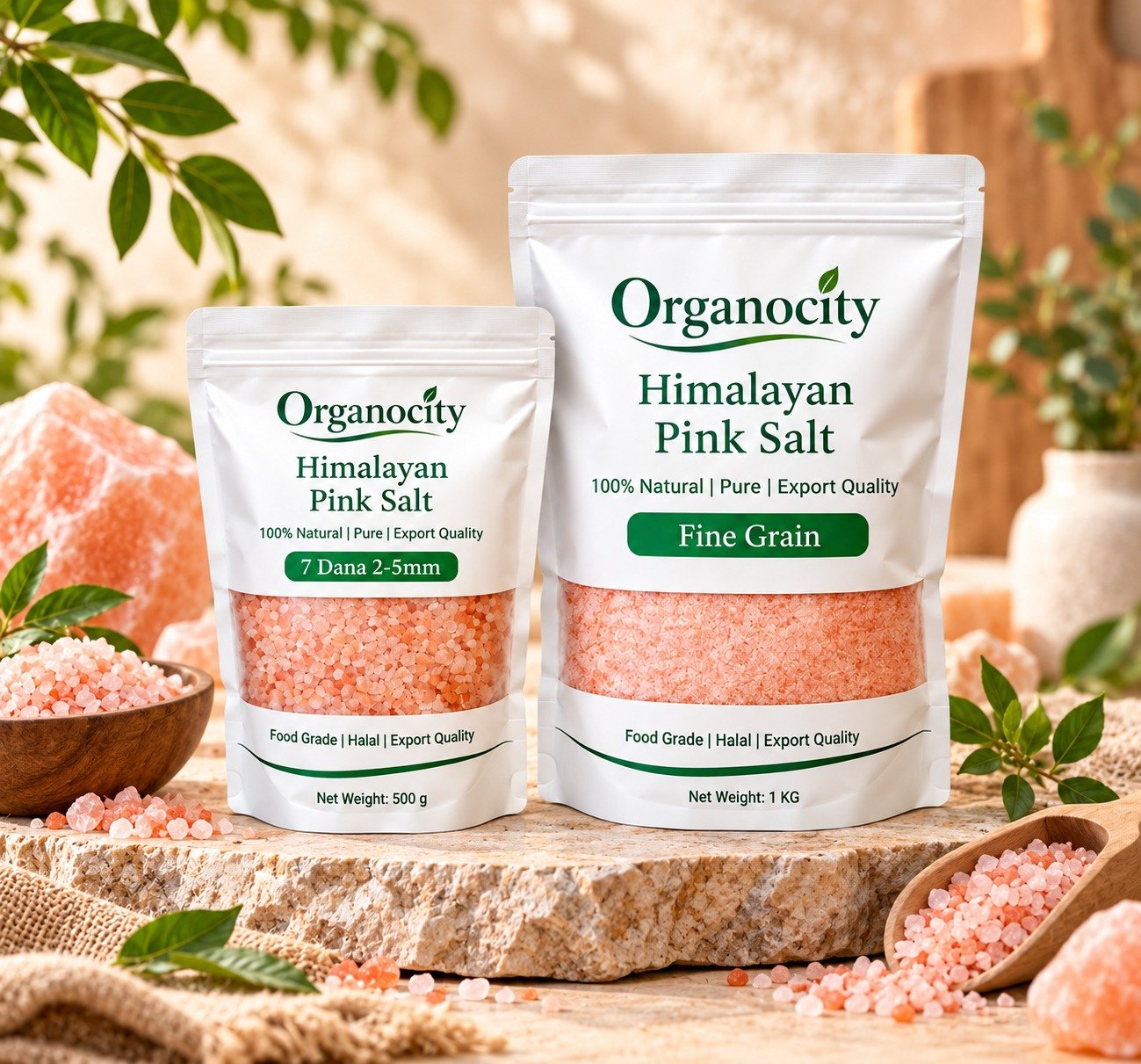
The pink salt price in Pakistan depends on grain size, packaging and quantity. Jars and grinders cost more per kilo than large bulk packs, but they are convenient and stay dry. At the time of writing, Organocity prices are:
- Himalayan Pink Salt Fine Grain, 250 g jar: Rs 150 (regular Rs 200)
- Himalayan Edible Pink Salt grinder jar: Rs 380 (regular Rs 500)
- Organocity Black Salt (Kala Namak): Rs 200 (regular Rs 300)
Prices can change, so check each product page for the latest price. Shops, restaurants and resellers can ask for our wholesale price.
Related guide: Shilajit Price in Pakistan: How to Buy Original Shilajit and Use It Safely
Frequently asked questions
Is pink salt better than white salt?
Pink salt is less processed and has no anti-caking additives, and many people prefer its taste. Nutritionally, it is very similar to table salt, so the amount you eat matters more than the type.
Can I use pink salt every day?
Yes, pink salt can be used every day for cooking and at the table. Keep your total salt intake within healthy limits and make sure you get enough iodine.
What is kala namak called in English?
Kala namak is called black salt in English. It is sometimes also called Himalayan black salt.
Where does Himalayan pink salt come from?
Most Himalayan pink salt comes from the Salt Range in Punjab, Pakistan, including the Khewra Salt Mine.
Does pink salt have iodine?
Pink salt contains only tiny, unreliable amounts of iodine. It is not a substitute for iodised salt.
Shop pure Himalayan pink salt
Organocity pink salt and kala namak are food grade, halal and hygienically packed in Swabi, KPK, with cash on delivery across Pakistan.
This article is for general information only and is not medical advice. If you have a health condition, follow your doctor’s guidance on salt intake.
References
- Fayet-Moore F, et al. An analysis of the mineral composition of pink salt available in Australia. Foods. 2020. Read the study
- World Health Organization. Salt reduction fact sheet. who.int


[…] Related guide: Pink Salt Benefits, Uses and Side Effects: Himalayan Pink Salt vs Kala Namak […]
[…] Related guides: Shilajit benefits for men and women · Pink salt benefits, uses and side effects […]